
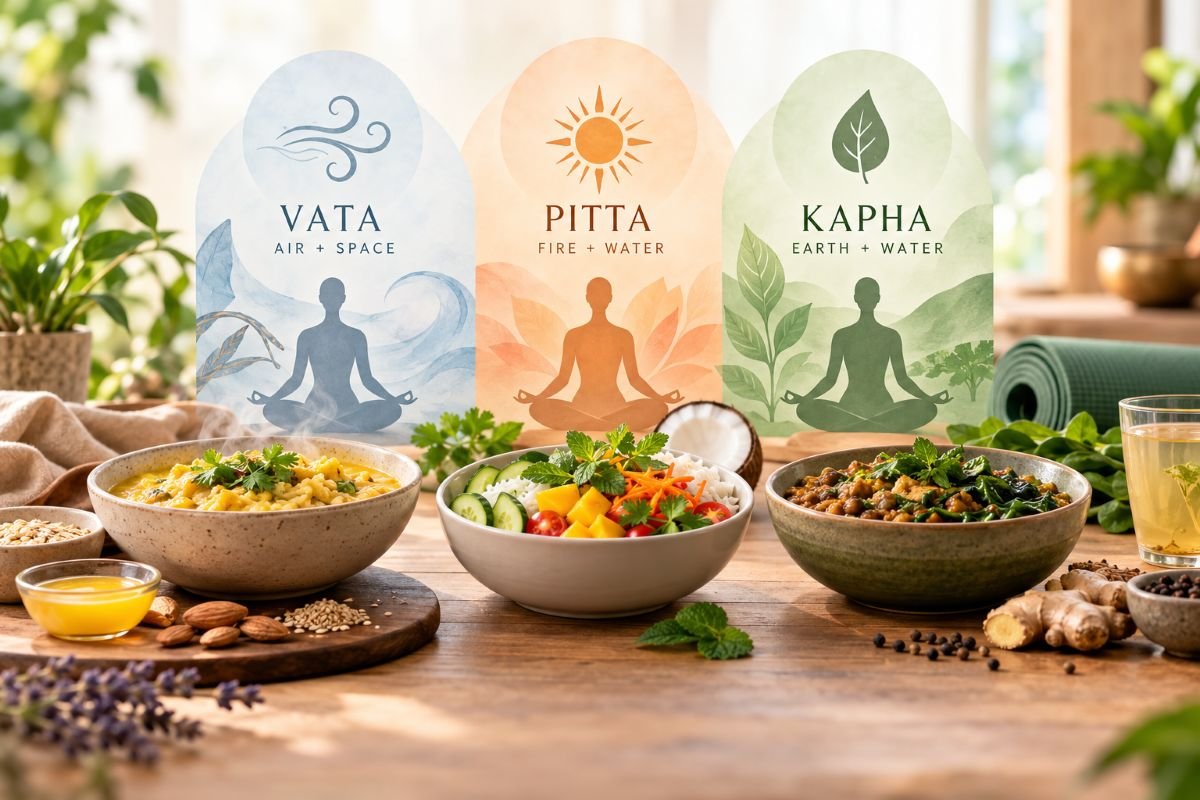
Have you ever noticed that your friend thrives on a big raw salad while the same bowl leaves you bloated and cold? Or that a spicy curry wakes one person up and gives another a burning stomach by evening? That is not random. It is exactly the puzzle the Ayurvedic diet set out to solve thousands of years ago.
Instead of one universal “healthy” plate, Ayurveda asks a more personal question: what does your body need? The answer lies in your dosha, your natural blend of energies. In this guide, you will learn what the three doshas are, find your own with a two-minute quiz, and pick up simple food swaps you can try this week.
What is a dosha, really?
In Ayurveda, everything in nature is built from five elements: earth, water, fire, air and space. In the body, these pair up into three doshas. Think of them as your personal weather pattern.
- Vata (air + space) is the mover: light, dry, quick and creative. Like a breezy day.
- Pitta (fire + water) is the transformer: warm, sharp, focused and driven. Like a bright summer noon.
- Kapha (earth + water) is the stabiliser: steady, soft, calm and enduring. Like a still, cool morning.
Everyone carries all three, but usually one or two lead. When your leading dosha is balanced you feel like yourself. When it runs high, you get familiar signals: restlessness or dry skin for Vata, irritability or acidity for Pitta, heaviness or sluggishness for Kapha. Food is one of the gentlest ways to nudge it back.
Quick quiz: find your dominant dosha
Grab a pen. For each question, note down the letter that sounds most like you most of the time, not on your best or worst day.
- Your body frame: (V) slim, hard to gain weight; (P) medium and muscular; (K) broad, gains weight easily.
- Your skin: (V) dry or rough; (P) warm, sensitive, prone to redness; (K) soft, smooth, oily.
- Your appetite: (V) irregular, sometimes I forget to eat; (P) strong, I get cranky when hungry; (K) steady, but I can easily skip a meal.
- Under stress you tend to: (V) worry and overthink; (P) get irritated or critical; (K) withdraw and go quiet.
- Your sleep: (V) light and easily disturbed; (P) moderate, wake hot; (K) deep and long, slow to get up.
Count your letters. Mostly V means Vata leads, mostly P means Pitta, mostly K means Kapha. A tie is completely normal: many people are a blend, such as Vata-Pitta.
Tell us in the comments: which letter won for you, and did it surprise you?
This quiz is a friendly starting point, not a diagnosis. A trained practitioner looks at pulse, digestion, lifestyle and season, which is what we do in a one-to-one session.
Eating for your dosha: what to favour and what to ease
The guiding idea is simple: like increases like, and opposites balance. So a dry, airy Vata does well with warm, moist, grounding food, while a fiery Pitta feels better with cooling choices.
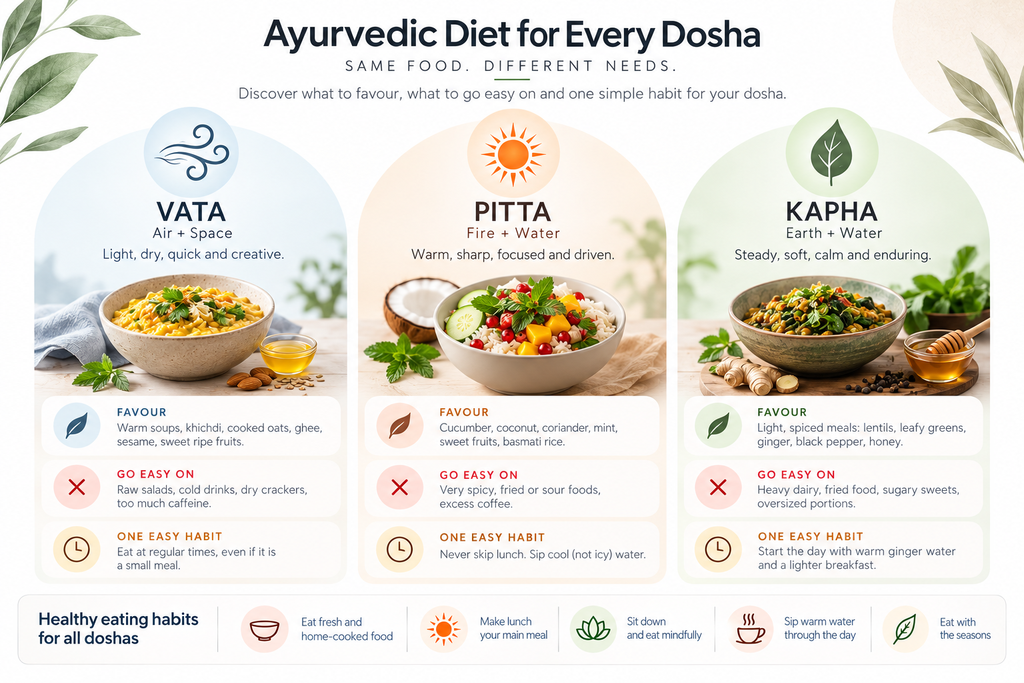
| Dosha | Favour | Go easy on | One easy habit |
| Vata | Warm soups, khichdi, cooked oats, ghee, sesame, sweet ripe fruits | Raw salads, cold drinks, dry crackers, too much caffeine | Eat at regular times, even if it is a small meal |
| Pitta | Cucumber, coconut, coriander, mint, sweet fruits, basmati rice | Very spicy, fried or sour foods, excess coffee | Never skip lunch; sip cool (not icy) water |
| Kapha | Light, spiced meals: lentils, leafy greens, ginger, black pepper, honey | Heavy dairy, fried food, sugary sweets, oversized portions | Start the day with warm ginger water and a lighter breakfast |
Notice the theme: nothing here is forbidden. It is about leaning toward what supports you and treating the rest as an occasional guest. If you are Pitta and love a spicy meal, enjoy it, then balance it with something cooling afterwards.
Try this: look at your last three meals. Which column would they fall under for your dosha? Circle one swap you can make tomorrow.
Yoga and nutrition: matching your plate to your practice
Your mat and your meals are two halves of one routine. In the yogic tradition, what you eat shapes how you move, breathe and think, which is why yoga and nutrition work best as a pair (we explore this further in our yoga and nutrition guide).
- Vata: favour slow, grounding practice such as gentle flows and long holds, followed by a warm, nourishing meal.
- Pitta: choose calming, cooling sequences and avoid practising on a very empty stomach, which can fuel frustration.
- Kapha: energising flows and breathwork suit you. Keep breakfast light so you feel lively rather than heavy on the mat.
A simple rule for everyone: leave two to three hours between a full meal and an intense practice, and take note of how you feel afterwards.
Food as medicine: the naturopathy diet mindset
The phrase food as medicine does not mean food replaces your doctor. It means everyday eating choices quietly support digestion, energy and mood, day after day. A naturopathy diet shares this spirit: whole, fresh, seasonal foods, eaten mindfully, with attention to how your body responds.
These habits suit every dosha, and are a lovely place to begin your journey into Ayurvedic nutrition:
- Eat fresh and freshly cooked. Warm, home-cooked meals are easier to digest than leftovers or packaged food.
- Make lunch your main meal. Digestion is usually strongest around midday.
- Sit down and slow down. Put the phone away and chew well.
- Sip warm water through the day instead of large glasses of cold water with meals.
- Eat with the seasons. Cooling foods in summer, warming foods in winter.
If you live with a health condition or take medication, please speak to your doctor before making big dietary changes.
Try this 3-day dosha challenge
- Day 1: Eat lunch as your biggest meal, seated and without screens.
- Day 2: Swap one meal for a dosha-friendly option from the table above.
- Day 3: Note your energy, digestion and mood in two lines before bed.
What changed? Even small shifts often show up quickly.
Quick answers
Can I follow an Ayurvedic diet if I am vegetarian or vegan? Yes. Most traditional Ayurvedic meals are plant-based, built around grains, lentils, vegetables, spices and healthy fats.
Can my dosha change? Your basic constitution stays the same, but imbalances shift with age, season, stress and lifestyle, so your food choices can too.
Do I need to give up my favourite foods? No. Balance beats restriction.
Your next step
If you would like guidance built around your body rather than a quiz, book a free consultation with Aaikyam Wellness. Our yoga therapist and holistic nutritionist, Suman Khound, weaves food and yoga into one personal plan. Which dosha are you? Tell us below.